Overview
The University of Birmingham grew out of the radical vision of its first Chancellor, Joseph Chamberlain. Founded in 1900 by Royal Charter, the University was England's first civic university — a place where students from all backgrounds were accepted on an equal basis. The university's roots were seeded in 1767 in the early medical education seminars of John Tomlinson, 'First Surgeon' to the Birmingham Workhouse Infirmary. Mason Science College was founded by industrialist and philanthropist Josiah Mason in 1875, before becoming Mason University College in 1898 and ultimately receiving its Royal Charter in 1900. Today, the Edgbaston campus has grown to cover 672 acres, and there is also a campus in Dubai.
The University of Birmingham was the first English university to be built on a campus model, the first to incorporate a medical school, the first to offer degrees in dentistry, and the first civic or 'redbrick' university, with students accepted regardless of their background or religion. It was also a founding member of the National Union of Students.
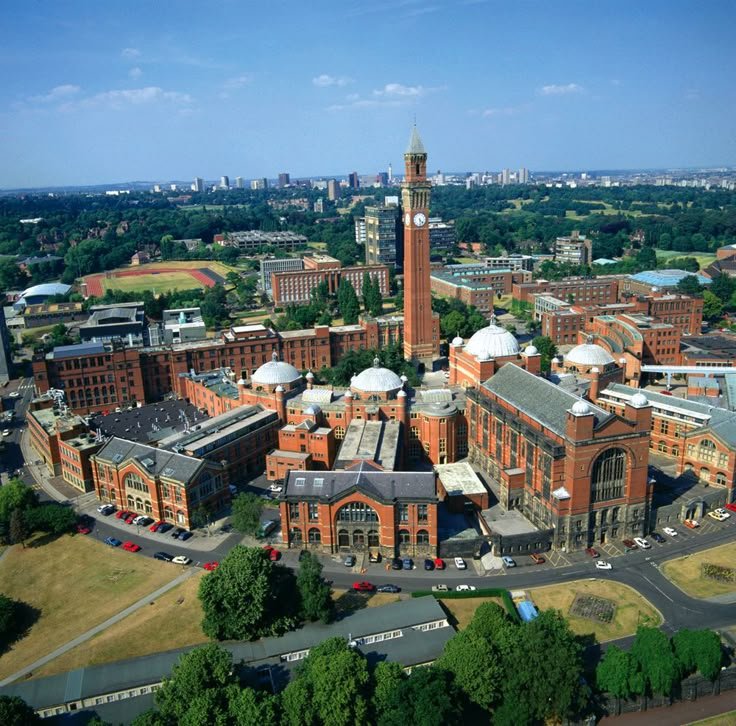
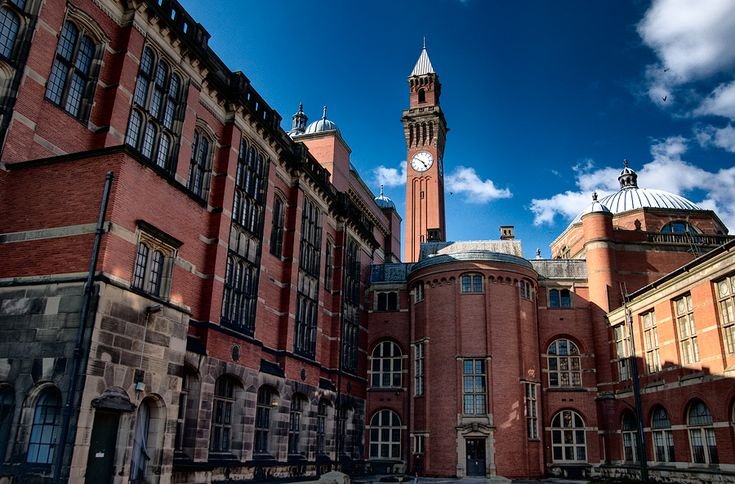
With around 10,000 staff, 38,000 students and 300,000 alumni across the globe, Birmingham thinks, recruits, and competes worldwide. Ranked in the top 100 universities globally and the top 25 in all domestic league tables, the university's main campus is in Edgbaston. The iconic Joseph Chamberlain Memorial Clock Tower — affectionately known as 'Old Joe' — remains the world's tallest free-standing clock tower, standing at the heart of Chancellor's Court. The Barber Institute of Fine Arts, a Grade II listed Art Deco building opened in 1939 by Queen Mary, exhibits original works by Van Gogh, Picasso, and other masters. Birmingham was one of the founding partners of Universitas 21, the global network of research-intensive universities.
Birmingham was again revealed as one of the top two UK universities most targeted by the country's leading graduate employers, according to 'The Graduate Market in 2026.' Birmingham hosts the Birmingham Centre for Railway Research and Education (BCRRE) — Europe's largest railway research centre — as well as a hub of the Alan Turing Institute and the Institute for Global Innovation. The university was also the first Global Top 100 and Russell Group university to open a campus in Dubai, and recently became the first university to partner with the YONEX All England Open Badminton Championships.
Notable alumni include Stanley Baldwin (three-time UK Prime Minister), Sir Neville Chamberlain (UK Prime Minister), Jess Phillips MP, Arabella Weir, and numerous leading figures in science, medicine, law, and public life.
Ranking
The University of Birmingham sits amongst the best-performing research-intensive universities in the world, sustaining increases in the QS World University Rankings 2026 to rank at #76 globally, and ranks #98 globally in the 2026 THE World University Rankings. It has climbed from #84 in QS 2024 to #80 in QS 2025 to #76 in QS 2026 — demonstrating consistent upward progress. Birmingham is ranked #16 in Europe by QS 2026 and #31 for International Research Network — its strongest performing area — demonstrating excellent global research connectivity.
The University of Birmingham continues to perform strongly in sustainability, now ranked #43 globally in QS Sustainability Rankings — demonstrating its commitment to the UN Sustainable Development Goals and to the UK's 2050 Net Zero target. In QS Subject Rankings, seven areas placing in the top 50 globally include: Dentistry, Education, English, Theology, Anatomy & Physiology, and Linguistics all in the top 50, and Sport in the top 10 globally at #9.
The University of Birmingham ranks #16 in the latest Times and Sunday Times Good University Guide 2026. In the QS Business Masters (Finance) Rankings, Birmingham is ranked #61 globally. The university has 8 Nobel Laureates among its alumni and stands #8 in UK for research power.
| Ranking Body | Rank |
|---|---|
| QS World University Rankings 2026 | #76 Globally / #11 in UK (up from #80 in 2025) |
| Times Higher Education (THE) 2026 | #98 Globally / Top 25 in UK |
| ARWU (Shanghai) | #101–200 Globally |
| US News Best Global Universities 2024 | #94 Globally / #10 in UK |
| CWUR 2025 | #93 Globally / #8 in UK |
| QS Sustainability Rankings 2026 | #43 Globally / #16 in UK |
| Times & Sunday Times Good University Guide 2026 | #16 in UK |
| QS — Sport-Related Subjects | #9 Globally |
| QS — Dentistry | Top 50 Globally |
| QS — Education | Top 50 Globally |
| QS — English Language & Literature | Top 50 Globally |
| QS — Anatomy & Physiology | Top 50 Globally |
| QS Business Masters (Finance) | #61 Globally |
| Graduate Employer Targeting 2026 (High Fliers) | Top 2 UK Universities most targeted by leading employers |
Intakes
The University of Birmingham follows the UK academic calendar:
- September Intake (Autumn) — Primary intake for all undergraduate and most postgraduate programs
- January Intake — Available for select postgraduate programs only
Application Deadlines (Indicative for 2026–27):
| Level | Deadline | Platform |
|---|---|---|
| Undergraduate (all students) | January 29, 2026 (UCAS deadline) | Via UCAS |
| Postgraduate Taught (MSc / LLM / MBA) | Rolling — most close by July 3, 2026 | Birmingham PG application portal |
| Postgraduate Research (PhD / MRes) | Rolling throughout year | Birmingham PG portal |
| MBA Programs | Rolling — early application advised | Birmingham Business School portal |
Note: Application fee: £22.50 (UG via UCAS, single choice); £27 (UCAS, multiple choices); £50 (PG direct). International students need a UK Student Visa. Birmingham guarantees accommodation for first-year international UG students who apply by July 31. Verify at birmingham.ac.uk/study/international.
Top Courses
The University of Birmingham offers over 600 taught and 140 research postgraduate courses, as well as 350 undergraduate courses across popular study areas including Engineering, Business & Management Studies, Law, Medicine & Health Sciences, Computer Science, and Science.
The university is organised into 5 Colleges comprising 11 academic schools. Key programs include:
College of Arts and Law:
- LLB in Law (3 years — #5 in UK, Complete University Guide 2025)
- BA in English Literature, History, Philosophy, Modern Languages
- LLM in International Commercial Law, LLM in International Human Rights Law
- MA in Creative Writing, MA in Cultural Studies
College of Engineering and Physical Sciences:
- BEng / MEng in Mechanical, Civil, Chemical, Electronic, Computer Systems, Software Engineering
- BSc / MSc in Computer Science (#10 in UK, CUG 2025 — up 47 places in QS 2026)
- MSc in Artificial Intelligence and Machine Learning (very popular with international students)
- MSc in Data Science, MSc in Cybersecurity
College of Medical and Dental Sciences (Largest Medical School in Europe):
- MBChB in Medicine (5-year single cycle — selective)
- BDS in Dentistry (5-year single cycle — QS Top 50 globally)
- BSc / MSc in Biomedical Science, Physiotherapy, Nursing
- MSc in Public Health, MSc in Global Health
Birmingham Business School:
- BSc in Commerce, Accounting, Finance, Business Management
- Full-Time MBA (top 10 UK, top 100 globally)
- MSc in Finance (#61 globally — QS Business Masters Finance)
- MSc in Business Analytics, MSc in Management, MSc in Marketing
College of Social Sciences:
- BSc in Psychology, Political Science, Economics, Sociology
- MSc in Social Policy, MSc in Development Economics
College of Life and Environmental Sciences:
- BSc / MSc in Biological Sciences, Geography, Environmental Science, Sports and Exercise Science
- BSc in Sport, Exercise and Health Sciences (#9 globally — QS)
Cost of Studying at University of Birmingham
More than £7.5 million in scholarships is available for international students coming to study at Birmingham. The fee can either be paid in full or spread over manageable instalments by Direct Debit. International undergraduate students who spend an entire year studying abroad or on an industrial placement will pay 50% of their tuition fee for the placement year.
The average starting salary for graduates from the University of Birmingham is £46,500, with degrees in fields such as business, law, and engineering yielding particularly high earnings. The University of Birmingham boasts an 87.2% placement rate within 5 years of graduation.
| Type of Expense | Annual Cost (GBP) | Annual Cost (INR Approx.) |
|---|---|---|
| Tuition Fees — BSc / BA / LLB (Overseas — Band 1: Arts/Social Science) | £19,020 – £19,740/year | ₹20,35,000 – ₹21,12,000 |
| Tuition Fees — BSc Engineering / Science / Computer Science (Overseas — Band 3/4) | £26,820 – £32,340/year | ₹28,70,000 – ₹34,60,000 |
| Tuition Fees — MBChB Medicine / BDS Dentistry (Overseas) | £37,310 – £43,190/year | ₹39,94,000 – ₹46,21,000 |
| Tuition Fees — MSc / MA (Overseas) | £17,580 – £37,800/year | ₹18,81,000 – ₹40,47,000 |
| Tuition Fees — MBA (Birmingham Business School) | £26,500 – £35,000/year | ₹28,36,000 – ₹37,45,000 |
| Tuition Fees — PhD / MRes (Overseas) | £21,840 – £26,040/year | ₹23,37,000 – ₹27,86,000 |
| Application Fee | £22.50–£50 (non-refundable) | ₹2,409–₹5,353 |
| NHS Health Surcharge (international) | £776/year | ₹83,100/year |
| On-Campus Accommodation | £4,680 – £12,480/year (£90–£240/week) | ₹5,01,000 – ₹13,35,000 |
| Food & Personal Expenses | £4,000 – £7,000/year | ₹4,28,000 – ₹7,49,000 |
| Transport (Birmingham — West Midlands Metro/bus) | £800 – £1,500/year | ₹85,600 – ₹1,60,500 |
| Total Estimated Annual Cost | £27,000 – £50,000 | ₹28,90,000 – ₹53,50,000 |
Note: Birmingham is significantly more affordable than London. Fees are charged in four fee bands based on subject type. International UG students benefit from a fee increase cap. Verify at birmingham.ac.uk/study/international/fees.
Scholarships
More than £7.5 million in scholarships is available for international students. At Birmingham, they are dedicated to supporting international students to join the university and recognise those who excel in their subject through a competitive scholarships offer.
Specific scholarships include the India High Fliers Undergraduate Scholarship (deadline May 31), the Computer Science International Excellence Scholarship (deadline June 30), LLB and LLB for Graduates Scholarships (deadline April 30), the India Birmingham Chancellor's Postgraduate Scholarship (deadline May 31), and the 125th Anniversary Scholarships (rolling deadlines).
Key scholarships for international students:
| Scholarship | Type | Value |
|---|---|---|
| India High Fliers UG Scholarship | Merit-based (India-specific UG) | Partial tuition reduction for outstanding Indian undergraduate applicants |
| India Birmingham Chancellor's PG Scholarship | Merit-based (India-specific PG) | Partial tuition reduction for Indian postgraduate students |
| Computer Science International Excellence Scholarship | Merit-based (CS-specific) | Partial tuition reduction for CS international students |
| LLB / Law International Excellence Scholarship | Merit-based (Law-specific) | Partial tuition reduction for outstanding Law international students |
| 125th Anniversary Scholarships | Merit-based | Various amounts; rolling deadlines — apply soon after receiving offer |
| Chevening Scholarship (UK Government) | Merit + leadership | Full tuition + living stipend + return airfare (1-year Masters) |
| Commonwealth Shared Scholarship | Commonwealth government | Full tuition + living allowance + return airfare (1-year Masters) |
| GREAT Scholarships (British Council — India) | Bilateral (India-UK) | £10,000 minimum toward PG tuition for Indian students |
| Birmingham PhD Scholarships | Research excellence | Full tuition + living stipend for exceptional doctoral candidates |
Admissions
The University of Birmingham's acceptance rate is approximately 13–15%, making it a highly selective institution. Indian applicants typically require 80% or higher in Class 12th depending on the program. English requirements range from IELTS 6.0 to 6.5 depending on the course.
For Undergraduate Programs (BA / BSc / BEng / LLB / MBChB):
- Completion of Class 12 (CBSE/ISC or equivalent) with 80–90%+ (program-dependent)
- A-Level equivalent: AAA to ABB (varies by program)
- IELTS 6.0–6.5 (no band below 5.5–6.0) / TOEFL iBT 80–95
- Application via UCAS; UCAS deadline January 29, 2026
For Postgraduate Programs (MSc / LLM / MBA):
- Bachelor's degree with minimum 2:1 Hons equivalent (55–65%+); competitive programs require higher
- IELTS 6.5–7.5 / TOEFL iBT 88–100 (program-specific)
- GMAT required for MBA programs
- Personal Statement, CV, 2 Academic References, certified transcripts
For PhD Programs:
- Master's degree with strong research record
- Supervisor agreement recommended before applying
- IELTS 6.5 / TOEFL iBT 88+
Placements
The University of Birmingham has an employability rate of 86%, with most graduates hired within six months of graduation. The average starting salary for graduates is approximately £32,000 per year, with business, law, and engineering graduates earning significantly more at an average of £46,500.
Birmingham was again revealed as one of the top two UK universities most targeted by the country's leading graduate employers, according to 'The Graduate Market in 2026.' This was its highest-ever placement in this prestigious employer-led survey. Birmingham's central UK location makes it an ideal base for students seeking careers with major UK and international employers across all sectors.
Birmingham — the UK's second city — is at the heart of the UK's most economically significant region outside London, with major corporate, healthcare, legal, and technology employers clustered in the Midlands.
Key career sectors for Birmingham graduates:
- Technology & Engineering — Capgemini, IBM, HSBC Technology, Siemens, Jaguar Land Rover, Rolls-Royce
- Finance & Consulting — Deloitte, PwC, KPMG, EY, HSBC, Barclays (all have major Midlands operations)
- Healthcare & Pharmaceuticals — University Hospitals Birmingham NHS Foundation Trust, GSK, AstraZeneca, Unilever Health
- Law — Leading Birmingham and national law firms, Government Legal Service, Crown Prosecution Service
- Consumer & Retail — Unilever, Royal Mail, Cadbury/Mondelez, Aston Martin
- Research & Academia — Alan Turing Institute, BCRRE, NIHR, leading UK universities
Jobs After Graduating from University of Birmingham
| Job Profile | Average Annual Salary (GBP) | INR Approx./Year |
|---|---|---|
| Software / Computer Engineer | £35,000 – £65,000 | ₹37,48,000 – ₹69,59,000 |
| Mechanical / Civil / Chemical Engineer | £32,000 – £55,000 | ₹34,26,000 – ₹58,89,000 |
| Medical Doctor / Clinical Specialist | £45,000 – £100,000 | ₹48,18,000 – ₹1,07,06,000 |
| Dentist / Dental Specialist | £40,000 – £80,000 | ₹42,82,000 – ₹85,64,000 |
| Lawyer / Solicitor | £35,000 – £85,000 | ₹37,48,000 – ₹91,00,000 |
| Financial Analyst / Banking | £32,000 – £70,000 | ₹34,26,000 – ₹74,95,000 |
| MBA Graduate / Business Manager | £50,000 – £90,000 | ₹53,53,000 – ₹96,37,000 |
| MSc Finance Graduate | £35,000 – £65,000 | ₹37,48,000 – ₹69,59,000 |
| Sports Scientist / Exercise Physiologist | £25,000 – £45,000 | ₹26,76,000 – ₹48,18,000 |
| Average Starting Salary (all graduates) | £32,000 – £46,500 | ₹34,26,000 – ₹49,78,000 |
Note: Salary figures are indicative annual gross values in GBP. International graduates may apply for the UK Graduate Route visa, allowing 2 years of post-study work (3 years for PhD graduates). Birmingham city is significantly more affordable than London.
For personalised guidance on University of Birmingham admissions, scholarships, and the UK student visa process, connect with the experts at Polygon Campus today.