Overview
Cornell University was founded on April 27, 1865, by Ezra Cornell — an entrepreneur, founder of Western Union Telegraph Company, and New York State senator — and Andrew Dickson White, an educator and fellow state senator. The university was established as New York's land-grant institution, with Ezra Cornell donating his farm in Ithaca, New York as the initial campus site and contributing $500,000 as the founding endowment. The university was formally inaugurated on October 7, 1868.
Cornell University is both a land-grant institution for the state of New York and a private, comprehensive research university in the Ivy League. Founded on the principle that any person can find instruction in any study, Cornell encourages students to take intellectual risks, explore the unfamiliar, and follow unconventional ideas.
Cornell was the first American university to be divided into colleges offering different degrees, and it was among the first Eastern universities to admit women (1870). It was also among the first university campuses in the world to use electricity to light its grounds from a water-powered dynamo in 1883.
Cornell University has a total student body of 26,793, comprising 16,128 undergraduate and 10,665 graduate students. Its diversity is evident, with students representing all 50 US states and over 130 countries. With over 16,000 undergraduate students, Cornell has the largest undergraduate population of any Ivy League university.
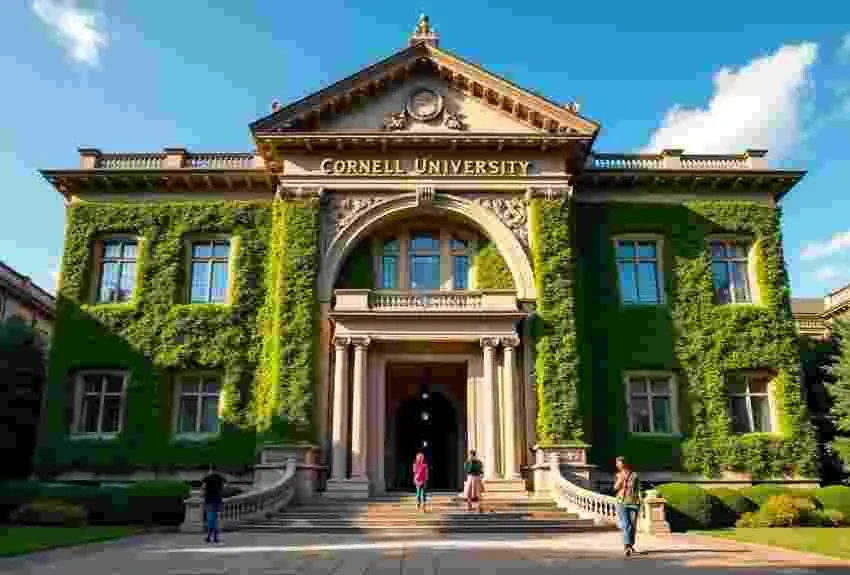
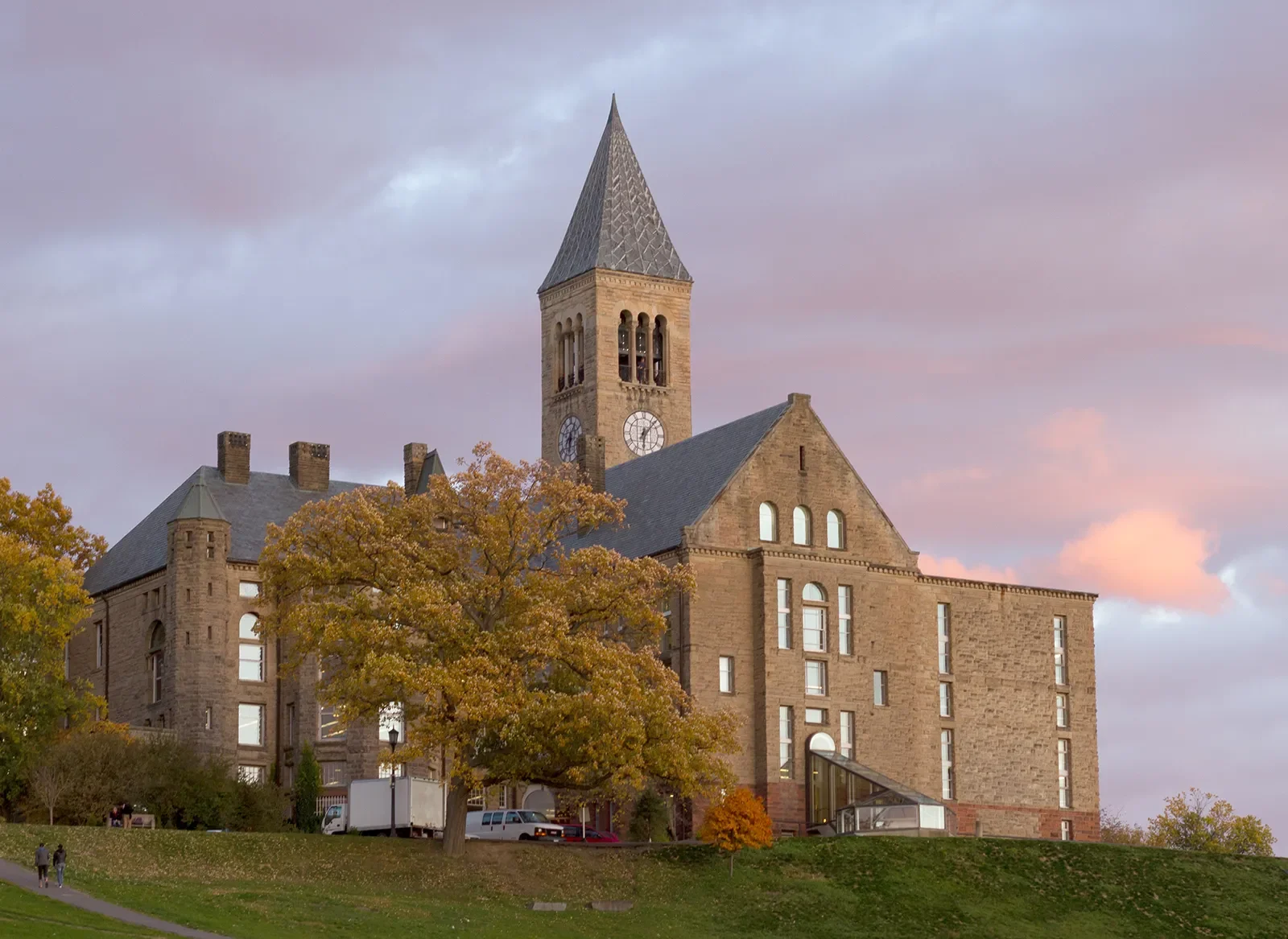
Cornell's main campus in Ithaca, New York spans approximately 745 acres, situated on East Hill with views of the city and Cayuga Lake. In 2011, Travel + Leisure recognised Cornell's campus as one of the most beautiful in the United States. As of 2024, the university's endowment stands at $10.7 billion, making it the 14th-largest among US universities.
As of October 2024, 64 Nobel laureates, four Turing Award winners, and one Fields Medalist have been affiliated with Cornell University. The institution counts more than 250,000 living alumni, including 34 Marshall Scholars, 33 Rhodes Scholars, 63 Olympic medalists, 10 current Fortune 500 CEOs, and 35 billionaires.
Cornell is the only institution in the world with four female alumni — Pearl S. Buck, Barbara McClintock, Toni Morrison, and Claudia Goldin — who have each won unshared Nobel Prizes. Other distinguished alumni include US Supreme Court Justice Ruth Bader Ginsburg, Taiwan's former president Tsai Ing-wen, writer E.B. White, inventor Willis Carrier, and scientist Carl Sagan.
| ~8% Acceptance Rate | 26,793 Total Students | 130+ Countries Represented | 64 Nobel Laureates |
Ranking
Cornell University ranks #16 globally according to the QS World University Rankings 2026. In the Times Higher Education World University Rankings, Cornell holds the #20 position globally, consistent with the previous year. According to the US News & World Report, Cornell is ranked #12 among National Universities in the United States for 2026.
In subject-specific rankings, Cornell holds the #3 position globally in Veterinary Science — its highest-ranked subject area. Cornell is also ranked among the top 20 globally for Architecture, Biological Sciences, Physics and Astronomy, Business & Economics, Life Sciences, and Computer Science.
Cornell's Johnson Graduate School of Management is ranked #31 globally in QS Global MBA Rankings 2025 and #5 among US business schools in the Financial Times Global MBA Rankings 2024.
| Ranking Body | Rank |
|---|---|
| QS World University Rankings 2026 | #16 Globally |
| Times Higher Education 2026 | #20 Globally |
| US News National Universities 2026 | #12 in USA |
| QS Veterinary Science (Global) | #3 |
| Financial Times MBA Rankings 2024 (Johnson) | #5 in USA |
Intakes
Cornell University offers admissions for both Fall and Spring intakes. The Fall intake is the primary and most common entry point for both undergraduate and graduate students.
- Fall Intake (August/September) — Primary intake; open to all undergraduate and most graduate programs
- Spring Intake (January) — Available for select graduate programs
Undergraduate Application Deadlines:
- Early Decision — November 1 (decisions in mid-December)
- Regular Decision — January 2 (decisions in late March/early April)
Graduate Application Deadlines: Graduate application deadlines are program-specific. Popular courses such as MS in Computer Science, Engineering Management, Architecture, Public Policy, and MBA typically close between January and April. Some programs stop accepting applications once seats are filled.
Note: Polygon Campus primarily assists with graduate-level admissions. Students are encouraged to confirm intake availability and deadlines with their chosen Cornell school or department.
Top Courses
Cornell stands out with over 80 undergraduate majors, 100+ graduate fields, and 7 undergraduate colleges, making it the most academically diverse Ivy League university. Cornell also operates the technology-focused Cornell Tech campus on Roosevelt Island in New York City.
Key colleges and their flagship programs include:
- SC Johnson College of Business — MBA (Two-Year, Executive, Tech-MBA), MS in Management
- College of Engineering — MEng in Computer Science, MS in Electrical & Computer Engineering, MS in Civil & Environmental Engineering, MS in Mechanical Engineering
- Cornell Tech (NYC Campus) — MS in Computer Science, MS in Information Systems, MBA in Tech
- Weill Cornell Medicine — MD, MD-PhD, MSc in Biomedical Sciences
- Cornell Law School — JD, LLM, JSD
- College of Agriculture & Life Sciences (CALS) — MS/PhD in Biological Sciences, Nutritional Sciences, Environmental Science
- College of Architecture, Art & Planning — Bachelor/Master of Architecture (ranked #1 nationally for multiple years)
- School of Hotel Administration (SHA) — BS and MS in Hospitality Management — world's top-ranked hospitality program
- ILR School (Industrial & Labor Relations) — BS/MS in Labor Relations, Human Resources, Organisational Behaviour
Cost of Studying at Cornell University
For the 2024–25 academic year, undergraduate tuition and fees at Cornell are $69,314. The total cost of attendance — including tuition, fees, room, board, books, and personal expenses — is approximately $92,150 per year for students living on campus.
Graduate tuition at Cornell is $30,160 per year for standard programs. Law school tuition is $85,412. Graduate students are charged $1,680 per credit hour.
| Type of Expense | Annual Cost (INR Approx.) |
|---|---|
| Undergraduate Tuition & Fees | ₹55,60,000 – ₹58,30,000 |
| Graduate Tuition (Standard Programs) | ₹17,70,000 – ₹58,30,000 |
| Johnson MBA | ₹70,80,000 – ₹1,10,00,000 |
| Law School (JD) | ₹71,00,000 – ₹75,00,000 |
| Room & Board (On-Campus) | ₹16,00,000 – ₹18,00,000 |
| Books & Supplies | ₹1,00,000 – ₹1,50,000 |
| Personal Expenses | ₹1,50,000 – ₹2,50,000 |
| Total Estimated COA | ₹75,00,000 – ₹92,00,000 |
Note: Figures are approximate based on 2024–25 official data. Please refer to Cornell's official website (finaid.cornell.edu) for the latest fee structure.
Scholarships
Cornell University met 100% of its students' demonstrated financial need. The average need-based scholarship or grant awarded to first-year students was $57,947. Additionally, 47% of first-year students received need-based financial aid in fall 2023.
Among all enrolled students, 50% receive grants or scholarships, with an average aid amount of $63,849 per student. After financial aid, the average net price drops to $32,238 for students receiving need-based aid.
Cornell offers need-based aid rather than merit-based aid or athletic scholarships. In the Class of 2025, 83% of full-time first-year students who applied for aid received need-based financial aid. The average Cornell grant award for a first-year student was $43,250, and as high as $72,800.
Key funding opportunities for international students include:
- Cornell Need-Based Grants — Covers 100% of demonstrated need; applicable to admitted students who apply for aid at time of application
- Tata Cornell Scholarship — A prestigious scholarship specifically for exceptional Indian undergraduate students admitted to Cornell University
- Johnson School MBA Fellowships — Merit and need-based awards for MBA students; typically range from partial to full tuition
- PhD Fellowships & Teaching Assistantships — Most PhD candidates at Cornell receive full funding through fellowships and assistantships, covering tuition and providing a living stipend
- Cornell Tech Fellowships — Financial support packages available for students at Cornell's NYC campus
- External Scholarships — Fulbright-Nehru, Inlaks Foundation, and Tata Trusts scholarships are accepted at Cornell
Note: International undergraduate students must apply for financial aid at the same time as they apply for admission. Late requests may not be considered.
Admissions
Cornell University received over 64,900 applications for the 2025–26 admissions cycle, of which only about 5,824 students were accepted — reflecting an overall acceptance rate of approximately 8.9%, making it one of the most selective universities in the United States.
Cornell follows a holistic, college-specific admissions process across its seven undergraduate colleges. Each college defines its own standards and evaluates applicants independently.
For Graduate Programs:
International graduate applicants must hold a bachelor's degree from an accredited institution and submit official transcripts from all previously attended universities. GRE or GMAT scores are required for some programs. Two to three letters of recommendation from faculty or professionals, and a statement of purpose outlining research interests and career goals, are also required.
- Bachelor's degree from a recognised institution
- GPA of 3.5 and above (3.8–4.0 recommended for top programs)
- TOEFL iBT: 100+ / IELTS: 7.5+ / Duolingo: 130+ / Cambridge C1/C2: 191+
- GRE / GMAT scores (varies by program; MS in Computer Science no longer requires GRE)
- 2–3 Letters of Recommendation
- Statement of Purpose
- CV / Résumé
For Undergraduate Programs:
Undergraduate applicants are expected to present strong Class XII results (around 90% or higher) along with competitive SAT/ACT scores and English proficiency scores.
- Strong academic record — top 10% of graduating class recommended
- SAT: 1500–1560 / ACT: 33–35 (note: SAT/ACT requirement reinstated for Fall 2026 onwards)
- TOEFL: 100+ / IELTS: 7.5+ for non-native English speakers
- 2 Teacher Recommendations + School Report
- Cornell-specific application essays
- Early Decision deadline: November 1 / Regular Decision: January 2
Indian students can check Cornell's specific admission requirements for their chosen program through Polygon Campus.
Placements
Cornell University has a 93% placement rate within six months of graduation — with graduates excelling in prestigious organisations including Google, Amazon, JP Morgan Chase, and Deloitte.
For the Class of 2024, Cornell's overall undergraduate placement rate was high, with the majority of graduates either employed or enrolled in graduate school within six months of graduation. The mean starting salary among undergraduates employed full-time in the United States was strong across all disciplines.
Cornell University's overall placement rate is approximately 89%, with graduates employed within 3 months of graduation. The average median salary of Cornell graduates is $135,000 per year. For MBA graduates of the Class of 2024 from the Johnson School, the placement rate was 79% within 3 months, with a median base salary of $175,000.
At Cornell Tech (NYC campus), technical program graduates who sought full-time employment achieved an 89% employment rate within three months of graduation. In 2024, the median salary for Cornell Tech graduates was $135,000, with employers including Amazon, BCG, SAP, NBC Universal, and Walmart.
Cornell's career support ecosystem includes:
- Cornell Career Services — Personalised advising, employer connections, recruiting events, and interactive outcomes dashboards
- Johnson School Career Management — Dedicated MBA career support with over 150 companies visiting campus annually to hire MBA graduates
- Cornell Tech Career Management — Specialised career support for NYC campus technology graduates
- Cornell Alumni Network (250,000+ living alumni) — A vast global network spanning every industry and country
- On-Campus Recruiting — Top employers including Google, Amazon, McKinsey, Goldman Sachs, JP Morgan, and Microsoft recruit directly at Cornell
- OPT & STEM OPT — International graduates can remain and work in the US for up to 12–36 months after graduation
Jobs After Graduating from Cornell University
| Job Profile | Average Annual Salary (USD) |
|---|---|
| Software Engineer | $1,20,000 – $1,60,000 |
| Investment Banker | $1,20,000 – $1,70,000 |
| Management Consultant | $1,50,000 – $1,80,000 |
| Johnson MBA Graduate | $1,75,000 (Median) |
| Data Scientist | $1,05,000 – $1,40,000 |
| Civil / Structural Engineer | $80,000 – $1,10,000 |
| Biomedical Researcher | $85,000 – $1,15,000 |
| Hospitality Manager (SHA) | $75,000 – $1,00,000 |
| Attorney / JD Graduate | $1,90,000 – $2,15,000 |
| Agricultural Economist | $75,000 – $1,05,000 |
Note: Salary figures are indicative and may vary based on role, employer, industry, and experience.
For personalised guidance on Cornell University admissions, connect with the experts at Polygon Campus today.
Campus Gallery